
CASE STUDIES
TitleTools
Building an AI-Powered Platform for the Title Industry

Building an AI-Powered Platform for the Title Industry

Title plants and examination shops run on documents (deeds, mortgages, liens, plats) that arrive as scanned images and have to be read, classified, keyed, and cross-checked by hand. Keying teams grind through packets page by page, examiners re-read documents that software should have read for them, and compliance checks like OFAC, FIRPTA, and bankruptcy live in separate tools with separate logins. Generic AI tools don't understand recording numbers, legal descriptions, or county quirks.

We built our own product. TitleTools is a cloud platform that pairs an in-house OCR and AI extraction engine, tuned on real county recordings from plants across the country, paired with an end-to-end examination workspace where every AI answer cites the exact page it came from. Document pipelines post straight to the plant, compliance screening is built into the workflow, and Parcel Watch turns the county recorder's daily feed into white-labeled alerts.

Limelyte has built title industry software for over a decade, and we're the original engineering team behind PropertySync, the cloud title plant platform managing decades of property records across counties nationwide. Year after year, the same pattern kept showing up in client work: enormous manual effort spent reading, keying, and verifying recorded documents that modern AI could handle, if someone built AI that actually understood title work.
So we built TitleTools. Not a generic document-AI tool with a title-industry label on it, but a platform designed around how title plants, keying operations, and examination shops actually work, launched at titletools.io and running in production today.

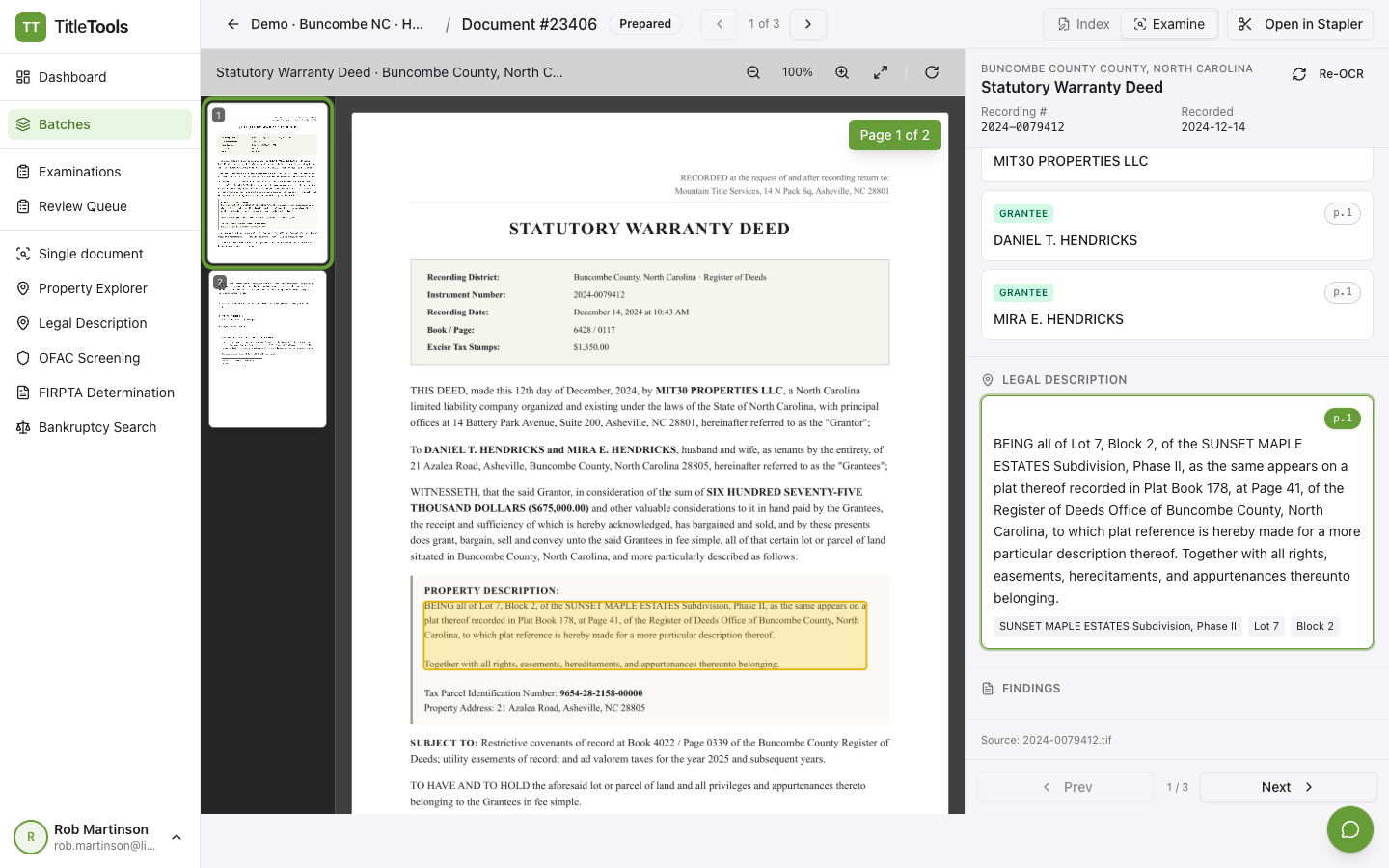
Recording packets come in from county ZIP files, S3 buckets, watch folders, or scheduled batches. Pages get cleaned and OCR'd, then our extraction engine, tuned on real county recordings from plants across the country, classifies each document and pulls the fields a plant needs: document type, recording number, parties, legal descriptions, parcel numbers, and cross-references. Every extracted value carries a confidence score, and a split-screen examine step lets operators verify low-confidence fields against the highlighted source pixels before anything posts.
The output is plant-ready: PropertySync transmissions, pipe-delimited files, custom CSV, or JSON. The same pipeline runs as full automation or as a first-pass extractor in front of an existing keying team. Either way, throughput per seat goes up and per-document cost goes down.
The Examiner workspace handles a complete title examination: AI splits and classifies the order's documents, pulls the county record to confirm the parcel, surfaces every covenant, lien, and easement as a discrete exception, and drafts a preliminary opinion from the extracted parties, legal, and vesting. The examiner verifies instead of types: every answer links back to the exact page and pixel region it came from, every override is recorded with who and when, and nothing ships without a signature. AI assists; the professional decides.
OFAC sanctions screening, FIRPTA determination backed by a licensed CPA firm, and federal bankruptcy search with PACER integration all live inside the same platform, with certificates and audit trails generated automatically. And Parcel Watch monitors the county recorder's feed every day: the moment a deed, lien, or mortgage is filed against a watched parcel, a plain-English email and text goes out under the title company's own brand.
TitleTools is what over a decade of title industry engineering looks like as a product. Explore the platform at titletools.io, or learn about our title industry solutions for custom plant work.
Related Case Studies:
PropertySync: Modernizing Title Plant Management |
Limelyte Extranet: 20-Year System Modernization


Our team is ready to handle projects of any size. Reach out to us with what you're looking for and we'll help prepare a project scope that fits your needs and budget.


